Home / LiDCO Hemodynamic System
LiDCO Hemodynamic System
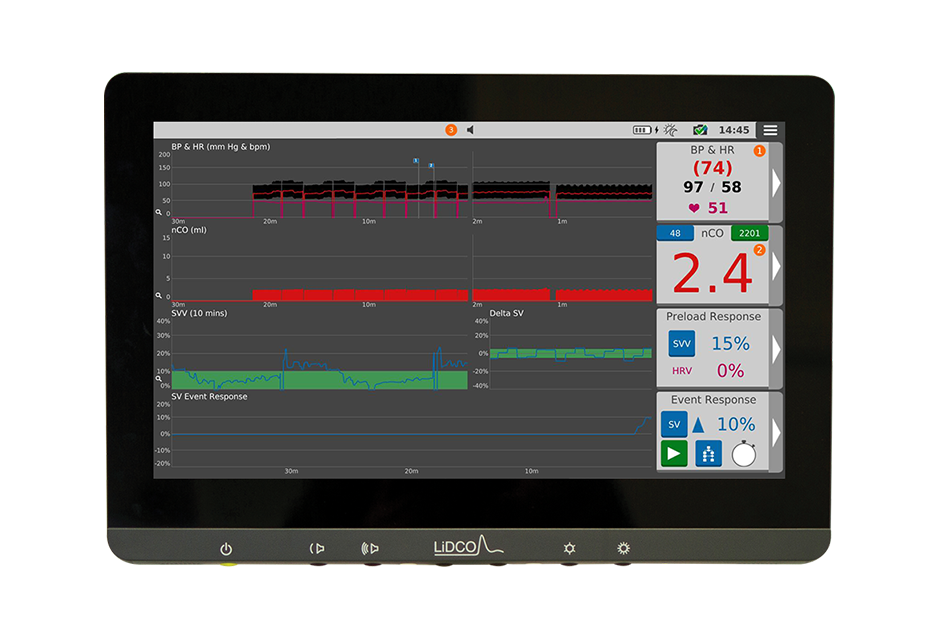
LiDCO® Haemodynamic Monitoring System
The LiDCO Haemodynamic Monitoring System provides beat-to-beat advanced haemodynamic monitoring to support informed decision-making in high-acuity care areas such as the Operating Room.
- Uses already existing arterial line and blood pressure transducer to monitor haemodynamic parameters
- PulseCO™ algorithm converts beat-to-beat blood pressure into its constituent parts, flow and resistance, scaled to each patient's age, height, and weight
- Proven to be reliable on patients on vasoactive drugs1
Clinical Evidence
Clinical Evidence
Reductions in Postoperative Complications and Costs
- In a randomised controlled trial of 734 patients undergoing major gastrointestinal surgery, researchers found haemodynamic optimisation with LiDCO led to more than 20% reduction in postoperative complications and, as a result, patients monitored with LiDCO were on average $530 less expensive to treat over 6 months than control patients who were not monitored.2, 3
Reductions in 30-Day and 180-Day Mortality
- In a study comparing the outcomes of 1200 major abdominal surgery patients, researchers found that, following the implementation of a program including LiDCO technology, there was a significant decrease in mortality at 30 days (from 21.8 to 15.5%) and 180 days (from 29.5 to 22.2%).3
Parameters and Indicators
Parameters and Indicators
The beat–to–beat parameters displayed by the LiDCO monitor provide immediate feedback on a patient’s fluid and haemodynamic status.
The LiDCO monitor provides the following parameters:
- Stroke Volume (SV): The amount of blood pumped by the left ventricle of the heart in one contraction
- Cardiac Output (CO): The amount of blood the heart pumps through the circulatory system in a minute, calculated by multiplying the stroke volume by the patient’s heart rate
- Systemic Vascular Resistance (SVR): Reflects the resistance to flow and is calculated as the quotient of pressure and cardiac output
- Oxygen Delivery (DO2): The amount of oxygen delivered to the issues, calculated as the product of cardiac output and oxygen concentration
- Stroke Volume Variation (SVV): A dynamic variable that can predict fluid responsiveness in mechanically ventilated patients, SVV is the variation in stroke volume across at least one respiratory cycle
- Pulse Pressure Variation (PPV): Another dynamic variable that can predict fluid responsiveness in mechanically ventilated patients, PPV is the variation in arterial pulse pressure across at least one respiratory cycle
- Arterial Elastance (EaDyn): The ratio of PPV to SVV, EaDyn helps predict blood pressure response to fluids in preload-responsive patients.5
- dP/dt: The rate of pressure change (dP) over time (dt) during isovolemic contraction of the ventricles, i.e. in the period before the aortic valve and/or pulmonic valve opens, when there isn’t considerable change in left atrial and /or right atrial pressure. It can be used as a measure of contractility.6
Key Features
Key Features
Easy Setup and Operation
Easy Setup and Operation
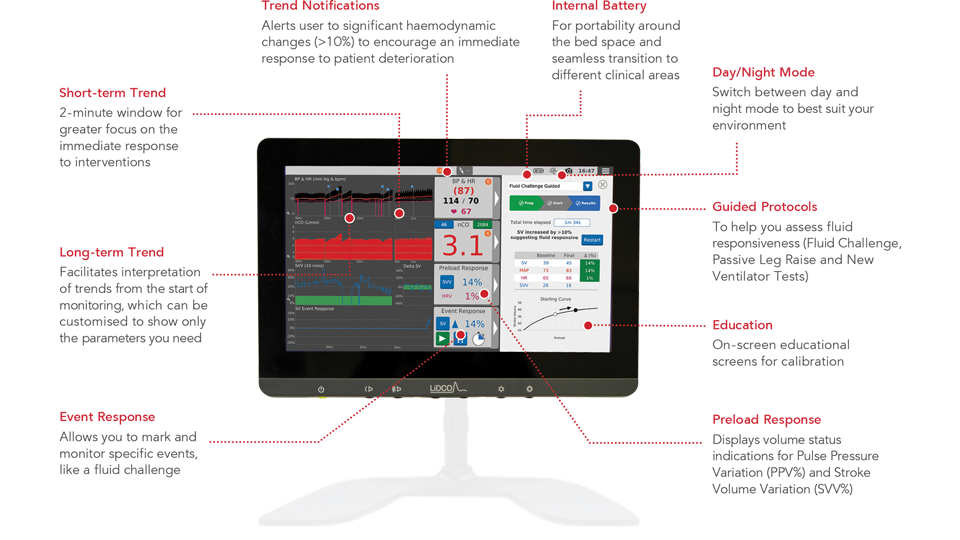
The LiDCO Monitor is designed for efficient setup and simple operation, with an intuitive, easy-to-interpret display—facilitating effective haemodynamic management even on those patients who are haemodynamically unstable and require fluid and drug support.
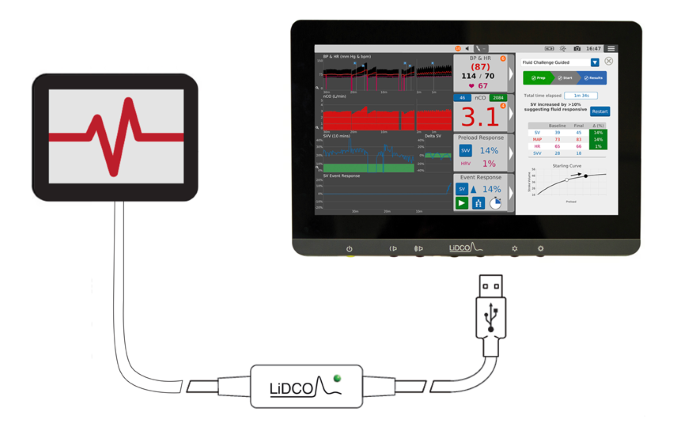
- Plug and play operations using the invasive blood pressure output port on the vital signs monitor
- Monitor using the existing blood pressure transducer, eliminating the need for an additional disposable
RESOURCES
References:
- 1.
LiDCO data on file.
- 2.
Pearse R et al. Effect of a perioperative, cardiac output-guided haemodynamic therapy algorithm on outcomes following major gastrointestinal surgery: a randomized clinical trial and systematic review. JAMA 2014; 311(21):2181-90.
- 3.
Sadique Z, et al. Cost-effectiveness of a cardiac output-guided haemodynamic therapy algorithm in high-risk patients undergoing major gastrointestinal surgery. Perioper Med (Lond). 2015 Dec 14;4:13.
- 4.
Tengberg LT et al. Multidisciplinary perioperative protocol in patients undergoing acute high-risk abdominal surgery. Br J Surg 2017 Mar; 104:463-471
- 5.
García et al. Dynamic arterial elastance as a predictor of arterial pressure response to fluid administration: a validation study. Crit Care. 2014 Nov 19;18(6):626. doi: 10.1186/s13054-014-0626-6. PMID: 25407570; PMCID: PMC4271484.
- 6.
Mason et al. Assessment of cardiac contractility. The relation between the rate of pressure rise and ventricular pressure during isovolumic systole. Circulation. 1971 Jul;44(1):47-58. doi: 10.1161/01.cir.44.1.47. PMID: 5561416.
For professional use. See instructions for use for full prescribing information, including indications, contraindications, warnings, and precautions.
PLCO-008000/PLM-12985C-1225